“Anyone who believes exponential growth can go on forever in a finite world, is either a madman or an economist.”
~Kenneth Boulding, Economics professor
Q: Does a growing economy require a growing population?Many Free Market economists say that business needs a growing population to be successful. But in reality, money buys things, not people.
For example: if you want to do well selling shoes, one Imelda Marcos is better than a whole town in rural anywhere. The number of feet to wear the shoes is irrelevant if they have no money to buy them.
Business doesn’t need more people to prosper, business needs people to prosper more.
Adjusting economic systems for improving population densitiesOur current economic system only seems to be dependent on an ever-increasing population. Actually, with increased density, some people benefit while others suffer. All non-human life suffers from human increase, but economic systems ignore that cost since it doesn’t have a price tag. So, let’s look at economics only as it affects the humans it’s meant to serve.
A large, expendable work force benefits owners, but it places labor at a disadvantage. Workers with dependents can’t afford to hold out on strike, or take chances on being permanently replaced. High unemployment reduces wages, while high demand for workers increases wages and benefits.
New housing provides jobs for construction workers and gains investors more capital for further development. However, much of the cost of increasing human habitat is borne by those who already live in the area: their taxes must increase to subsidize population growth. With a shift in priorities, maintaining and improving existing buildings could provide as many jobs as new construction provides.
Landlords fare better when population increases because higher demand for rental units equals higher rent payments. Tenants benefit from a shrinking population as housing becomes more affordable.
Real estate speculators make money from rising property values, which are driven by demand for that property. Homeowners who wish to stay where they are must pay more in taxes when their homes are worth more on the market.
Businesses which focus on the needs of infants and young people will have fewer customers as birth rates improve, however, fewer customers doesn’t automatically mean less income. Many potential consumers can’t afford the products offered, and with smaller families, just as much money could be spent on children’s products. Often, companies also cater to other age groups, and money not spent on children’s needs is available for those products and services.
Education may seem dependent on an increasing, or at least a steady flow of new students. However, providing adequate education over-taxes local economies, and many citizens resist paying. With fewer students, class sizes could improve, and capital expenditures for new schools would shrink. Existing schools could get their needed repairs and improvements. As with diversification in other businesses, public schools could cater to wider age groups and increase their customer base.
Chain letters involving money, and pyramid financial arrangements such as Ponzi schemes, are illegal, since they benefit the first to get involved and collapse when there are no longer enough new people paying in. Outlawed in the private sector, many government retirement systems unsustainably depend on increasing numbers of wage earners to pay entitlements. Systems dependent on growth eventually fail, as pyramid scams and empires always have.
When our population density begins to improve, and sensible adjustments are made, economic systems as a whole will become more sustainable and potentially more just.
Economies dependent on population growth equated to Ponzi schemes.
Population growth equated to Ponzi scheme.

Q: Who will pay our social security when we’re old?
The new demographics that are causing populations to age and to shrink are something to celebrate. Humanity was once caught in the trap of high fertility and high mortality. Now it has escaped into the freedom of low fertility and low mortality. Women’s control over the number of children they have is an unqualified good—as is the average person’s enjoyment, in rich countries, of ten more years of life than they had in 1960. Politicians may fear the decline of their nations’ economic prowess, but people should celebrate the new demographics as heralding a golden age.~Editorial from The Economist January 7, 2006
Despite the wisdom of the above quote, it is a rare expression of lower birth rates’ positive side. Those who benefit most from an increasing population density—identified in the previous Q & A—also happen to own or finance major media outlets. As a result, we are regularly told that an economic crisis looms if we don’t breed more future workers. A Washington Post reporter wrote of “countries struggling with the threat of zero population growth.”
Although most systems of providing for retired citizens are financed by taxing working citizens, the concept of needing younger people to support older people is obsolete. If used responsibly, products from the industrial and technological revolutions could satisfy our needs without selling our children into wage slavery.
Automation removes more workers from payrolls than birth control does. Owners of the machines gain the “wages” formerly paid to workers, without paying a percentage into pension funds.
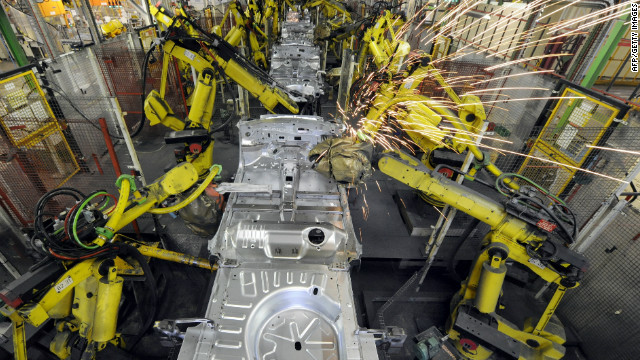
These “workers” pay no social security taxes.
Unemployment levels reveal that we already have enough potential workers. Increasing employment opportunities and improving wages would increase funds paid to social security.
Social security systems are artificial, so adjustments for changes such as a reduction in the number of potential workers can be made.
In the USA, a pea-and-shell game is being played on taxpayers. More money is taken in for social security than is shelled out, but the remainder vanishes instead of being invested for future pensioners. The solution to having our nest eggs stolen isn’t to lay more eggs.
US Social Security Trust Fund solvency.
Q: Is conservation the answer to resource depletion?
Each new human we don’t create is the equivalent of more than 70 years of 100% recycling. We save over 50 years of car driving, avoid tons of pollution, and prevent the potential for an additional procreation less than 20 years later.
When the impact our descendants’ descendants have on Earth’s biosphere is added to what we are saving, it becomes astronomical. And, if we decide to not make two more of us, we save astronomical doubled.
Volunteers who are ready to make even more of a commitment might consider not producing 10 new people: 720 human-years of industrial consumption and pollution can be saved by just one pair of us. Congratulations!
All kidding aside, and that’s a good place to put “kidding,” running out of resources mostly concerns humanity, not the ecosphere. Conservation usually means use it up more slowly. One conservation organization’s motto: “Conserving natural resources for our future.” Resource extraction disrupts ecosystems, so when a resource is all gone, life might start to recover there.
Many believe that Earth could supply an endless amount of resources. “The Economist” magazine for example: “The notion of a growing number of people fighting over a fixed resource pie is Malthusian bosh . . . ”
Cornucopian pie-in-the-sky might look tastier, but bosh is all we’ll be able to sink our teeth into on a finite Earth.
Although humanity has reason to fret over material and energy shortages, loss of wildlife habitat diminishes life far more, and we don’t even count it. It’s not a resource if we can’t use it. Unlike copper, which the late Julian Simon assured us could be made out of something else if we run out, wilderness areas are definitely finite.
If we cut our per capita consumption in half and double our numbers, we’ll be right back where we started.
Societal Overextention Analysis adds economic overshoot to ecological overshoot for a more complete picture of our situation.
More on Julian Simon’s arguments. To be fair, Simon meant the economic equivalent of copper could replace copper. Fiber optic cable is doing so in communications and PEX tubing is replacing copper water pipes.Cornucopian delusions: Is there really no limit to human population size and the resources to sustain us?
Lifetime mineral usage of average US resident: seven billion tons (pdf).
Offset your carbon emissions by helping prevent unwanted conceptions.
Q: Isn’t over-population worse in poor countries?There are two main aspects to over-population: the ecological and the human.
In countries with high birth rates and recurring famine, the impact on humans is greatest. In countries with lower birth rates and high consumption, the environmental impact is greatest. We need to work in both of these areas to relieve human suffering and ecological degradation.
At present, a human born in the wealthy part of the world has a much greater environmental impact than one born in a poor country. However, activities of poor agrarian peoples also have an impact on the environment.
Gathering firewood and grazing at the edges of deserts causes the deserts to expand. Hungry people are kept out of game preserves in Africa by shooting trespassers. As the number of hungry people grows, this gruesome task will become more difficult. If a government is overthrown and the game wardens temporarily removed, many major species could be hunted to extinction in a short time.
Pollution from a crowded city in a non-industrialized country is shorter-lived than from our industrialized cities. Chernobyl will be radioactive for 24,000 years, while organic pollution will flush out of a river in a few years.
So-called developing countries are gaining on industrialized nations in their consumption of fossil fuels and production of toxic wastes. Much of this industry is being imported from industrialized areas to take advantage of cheaper labor. Cheaper labor is another result of high birth rates.
Whether we’re living abundant lives or are starving, our lives and the planet’s health will be most improved by refraining from reproduction.
Above graphic from a US Federal Reserve pamphlet c.1960
Q: Isn’t unequal distribution of wealth the cause of hunger rather than over-population?
Compelling evidence supports this contention. A small percent of the world’s population is using most of the energy and resources. Equal distribution, if possible, would likely end hunger for a while.
Setting aside for a moment the fact that people who aren’t created won’t starve, the single greatest cause of hunger today is economic exploitation. Instead of growing food, exploited regions must raise cash crops to pay the interest on national debts. Profit from natural resource extraction could provide for people’s needs if it weren’t for people’s greeds.
More conservation by us consumption-addicts is only fair, but the lion’s share of Earth’s plunder is controlled by a fraction of one percent of humanity. Brute force sustains this ancient world order, same as it ever has.
Phasing out the human race won’t automatically bring about economic justice, but it will make it possible. The smaller our human family, the easier feeding everyone at the dinner table will be.
From an Earth-centered view, we’re pluckin’ a mighty skinny chicken here, and it doesn’t matter to the chicken who gets the drumstick and who gets the neck.
US Census Bureau’s estimated number of servings needed for today’s dinner table.
Although everyone on Earth could theoretically be fed, the fact remains that they simply are not. A billion people are not getting enough to eat, and around 36 million are starving to death each year—one third of them children.
In 1970, when the global human population stood at 3.7 billion, the main architect of the Green Revolution, Norman Borlaug, said:
“There can be no permanent progress in the battle against hunger until the agencies that fight for increased food production and those that fight for population control unite in a common effort. Fighting alone, they may win temporary skirmishes, but united they can win a decisive and lasting victory to provide food and other amenities of a progressive civilization for the benefit of all mankind.”Instead, all the increased agricultural yield has been gobbled up by population growth. Although the percentage of hungry people has decreased—from 37% in 1970 to 17% in 2007—the raw number of malnourished people has continued to increase. There are more hungry people now than the entire population of the planet was when Malthus warned of our population growing faster than our food supply.
Food production has almost kept up with us—or us with it—at a huge ecological cost. Farming on performance-enhancing drugs produces more food, but it’s at the expense of long-term fertility of the soil. Now the UN warns that food production must double by 2050 to satisfy nine billion people’s appetites. Estimated cost of boosting output: $1.9 trillion a year. That would buy a lot of contraception.
For the famous photo of a Sudanese child crawling toward a feeding station while a well-fed vulture follows in case she doesn’t make it: Not recommended viewing by those already suffering from depression over the human condition.
Modern agriculture and food security, links to sources.
Q. Wealthy countries have low fertility rates, so why not just increase a nation’s Gross Domestic Product and let birth rates fall naturally?
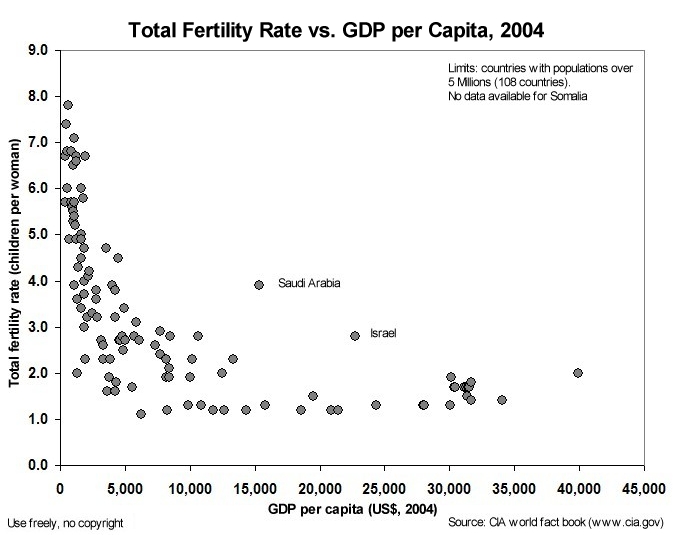
The correlation between TFR and GDP shown above is often presented as evidence that poverty causes high birth rates. It could just as easily show that high birth rates cause poverty. Are people procreating more because they are poor, or are they poor because they procreate more? Many countries have low birth rates and low per capita GDP, so other factors are likely involved.
A dynamic chart from Gapminder shows TFR and per capita income over time.
Where there’s a cultural preference for large families, subjugation of women, and a lack of reproductive freedom, economics is likely to have less influence on TFR.
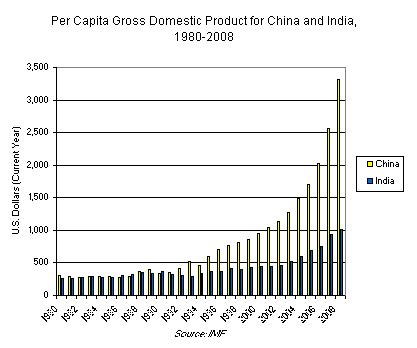
India’s fertility rate is 2.35, while China’s is 1.6 (2020 CIA estimates).China’s improved fertility rate likely played a major role in improving per capita GDP. Improvements have also followed lower birth rates in Vietnam, and Thailand. This Demographic Dividend typically lasts a few decades and could serve as a transition from an economy based on growth to one with an improving population density. Short term planning, exploitation, and civil unrest often squanders this window of opportunity, as in Sri Lanka.
Models of the demographic transition from high birth and death rates to low birth and death rates generally assume that an increased standard of living, also called economic development, is the primary driver. Social improvements such as a higher status for women, reproductive health care, and increased education opportunities are given less weight than economic factors. However, lower fertility and subsequent lower mortality have been achieved without economic development in Bangladesh and the Indian state of Kerala. Also, families have improved their standards of living by voluntarily limiting their fertility.
Vietnam's fertility rate 1960 to 2020Although a smaller population from reducing birth rates benefits
My statement that “development is the best contraceptive” became widely known and oft quoted. 20 years later I am inclined to reverse this, and my position now is that “contraception is the best development.” – Karan Singh, Indian politicianIn the last century, organizations bringing health care to poor nations dramatically reduced mortality, but reproductive health services were negligible and remain sadly inadequate. The result is a lag between improved death rates and improved birth rates, multiplying population density several times over. Now, many nations are caught in a demographic trap, unable to provide adequate food and services for their masses, nor to improve birth rates.
Because wealthy nations have lower birth rates, it’s assumed that increased income causes couples to want smaller families. In reality, when couples perceive a better future they’re likely to have more children and to have them sooner. US birth rates fell to a historical low during the Great Depression of the 1930s, and rebounded with a Baby Boom during post war economic optimism. Migration to a wealthier region usually increases a couple’s fertility.
Although economic justice demands higher standards of living for billions of humans, without other social advancements, fertility rates will rise with economic improvements—ultimately negating those improvements.
As globally-interdependent financial pyramid schemes fall apart, and wealth continues to be transferred upward, personal economic adversity is likely to lower birth rates in regions where contraceptives are available and women’s right to use them is respected.
Reproductive choices influenced by economic conditions: Birth rates in US, August 2010, June 2020, and in UK, February 2011.
Further informationVirginia Abernethy analyses Demographic Transition Model.
Endogenous relationship between income and birth rates analyzed.
Only after the last tree has been cut down,
Only after the last fish has been caught,
Only after the last river has been poisoned,
Only then will you realize that money cannot be eaten. ~ Cree Indian Prophecy
Q: Is capitalism the main cause of environmental destruction?
Modern economies are still based on the ancient slash-and-burn method. This method assumes that there are unlimited resources and that unlimited growth is possible. We know this isn’t true, yet we allow our economies to be run as if it were.
Slash-and-burn was sustainable for thousands of years in sparsely populated regions. When a people returned to an area that had been slashed and burned, the resources had recovered enough to do it again. We’re still slashing and burning, but now there’s no recovery time due to our increased numbers and subsequently shorter cycles.
Most modern industrial economies are dependent on large expendable labor pools, availability of raw materials, scarcity of goods, and unlimited wants.
A sustainable economic system is based on the reality of limits to growth and a concern for long-term effects. Rather than using up resources and throwing away the waste, a sustainable system conserves and reuses.
To keep the resource-exploitation machinery running, we are sacrificing the planet’s true wealth: life itself. This insatiable monster seems bent on consuming all life on Earth, and we are working overtime to keep it fed. It feeds mainly on our offspring. We should let it starve.
CASSE: Center for the Advancement of the Steady State Economy
“Big Idea: A Steady-State Economy” Adbusters Magazine
Next category: POLITICS